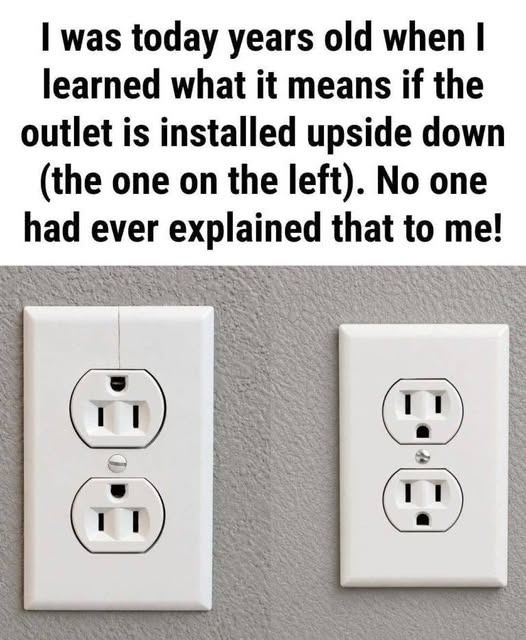
Have you ever noticed that some electrical outlets seem to be installed upside down? Many people have. We glance at them, assume someone made a mistake during installation, and move on without giving it another thought.
For years, many people believed the same thing.
But an outlet with the ground hole at the top is not necessarily installed incorrectly. In many situations, this orientation is intentional and can be related to practical considerations such as safety, identification, or installation preferences.
This small discovery reveals something interesting about everyday objects:
many things we use daily have a purpose that is not immediately obvious.
So let’s explore what an upside-down outlet actually means, why electricians sometimes install them this way, and why there is not always just one “correct” orientation.
The First Surprise
If you look closely at a standard electrical outlet, you may notice its familiar face-like appearance. The two vertical slots resemble eyes, while the round grounding hole looks like a mouth.
Most homes have outlets installed with the round grounding hole at the bottom. Because this is the
version most people see, it has become the orientation that feels normal.
However, you may sometimes find outlets in hospitals, offices, workshops, or homes where the grounding hole is positioned at the top.
At first glance, it can look like someone installed it incorrectly.
The reality is more interesting.
Why Install an Outlet Upside Down?
One reason involves electrical safety considerations.
Imagine a plug that is only partially inserted into an outlet. If a metal object, such as a screwdriver, paper clip, or another conductive item, falls between the plug
and the outlet, it could potentially come into contact with electrical contacts.
When the grounding hole is positioned at the top, the grounding pin may make contact first. In certain situations, this orientation is considered by some electricians as an additional safety consideration because it can reduce the likelihood of a conductive object reaching energized parts first.
This does not eliminate every possible electrical hazard, but it is one reason this orientation is sometimes chosen.
You may see this type of installation more often in commercial buildings, healthcare facilities, and
other locations where electrical systems are carefully planned.
Behind this unusual position is a reason many people never notice until someone explains the hidden logic behind it.
Hospitals Often Use This Orientation
Hospitals are among the places where ground-up outlets are commonly noticed.
Medical environments rely on electrical equipment constantly, so installation details are carefully considered.
Some facilities use outlets with the grounding hole facing upward as part of their electrical installation practices, especially where equipment safety and organization are important.
Although electrical standards and practices vary depending on location,
this orientation has become familiar in many healthcare settings.
Commercial Buildings Follow Similar Practices
Many offices, laboratories, schools, and industrial buildings also use outlets with the grounding hole at the top.
Electricians working on commercial projects may follow building plans or engineering specifications that request this type of installation.
Reasons can include:
Improved safety considerations.
Consistent installation throughout a building.
Easier identification of certain circuits.
Following project specifications.
If you have noticed upside-down outlets in an office building, there is a good chance they were installed intentionally.
Is It Required
by Electrical Code?
This is where many people become confused.
In many locations, electrical codes do not require all outlets to face one specific direction. Both ground-up and ground-down orientations may be acceptable when the outlet is installed correctly and meets local requirements.
The important factor is not whether the grounding hole is on the top or bottom, but whether the electrical installation is safe and properly completed.
An electrician may install an outlet with the grounding hole on the top, bottom, or in some cases another orientation depending on
the situation and local practices.
Why Most Homes Have Them Ground Down
If ground-up outlets can be useful, why are they not used everywhere?
The answer is largely tradition and familiarity.
Residential construction has historically favored outlets with the grounding hole at the bottom. Over time, homeowners became accustomed to seeing them this way.
Manufacturers often display products in this familiar orientation, and furniture designs are usually created around what people recognize.
Sometimes, what feels “correct” is simply what we have seen most often.
The next detail reveals another reason
some electricians choose a different outlet direction in everyday homes.
An Easy Way to Identify Switched Outlets
Another interesting reason involves switched outlets.
In many homes, one half of a duplex outlet can be controlled by a wall switch, allowing a person to turn a lamp on or off without touching the lamp itself.
Some electricians install these switched outlets upside down as a way to make them easier to recognize.
Instead of opening the electrical box or testing the circuit, the unusual orientation can serve as a visual clue
that the outlet may have a special function.
This is not a universal rule, but it is a practice used by some electricians.
What About Sideways Outlets?
Not every outlet is installed vertically.
In kitchens, furniture, conference tables, and specialized installations, outlets are sometimes mounted horizontally.
This does not automatically mean something is wrong.
The orientation often depends on:
Available space.
Furniture design.
Accessibility.
Installation preferences.
The electrical performance remains the same as long as the outlet is installed correctly.
The Role of the Grounding Pin
To understand why orientation
matters, it helps to understand the purpose of the grounding pin.
The round hole connects to the electrical grounding system. Its purpose is to provide a safer path for fault current if something goes wrong inside an appliance.
Without proper grounding, exposed metal parts of equipment could become energized, increasing the risk of electric shock.
For this reason, removing the grounding pin from a plug just to make it fit an older outlet is not recommended.
If a home has outdated or ungrounded outlets, the safest approach is to have
the electrical system evaluated by a qualified professional.
Common Myths About Upside-Down Outlets
Myth 1: The Electrician Made a Mistake
Not necessarily.
Many upside-down outlets are installed intentionally for practical reasons.
Myth 2: They Are Dangerous
When installed correctly, they can function safely like traditionally oriented outlets. In some situations, this orientation may be selected for additional safety considerations.
Myth 3: They Mean the Wiring Is Wrong
The direction an outlet faces does not tell you whether the wiring inside is correct.
A properly wired outlet works regardless of whether
the grounding hole is at the top or bottom.
Myth 4: They Are Only Found in Hospitals
Although they are common in some healthcare settings, upside-down outlets can also be found in homes, offices, schools, and commercial buildings.
There is one final lesson hidden behind this small electrical detail that applies to many things we see every day.
Should You Turn Yours Around?
If you are thinking about rotating your outlets after learning this information, consider why you want to change them.
Changing the orientation usually provides little practical benefit
if the outlet is already functioning correctly and safely.
If you are remodeling or replacing outlets, you can discuss your preferred orientation with a qualified electrician.
Other Safety Features Matter More
Although outlet orientation attracts a lot of attention, other electrical safety measures often have a greater impact.
These include:
Ground Fault Circuit Interrupter (GFCI) protection in areas such as kitchens, bathrooms, garages, and outdoor spaces.
Arc Fault Circuit Interrupter (AFCI) protection where required.
Tamper-resistant outlets that help protect children.
Proper grounding throughout the electrical system.
Regular inspection of damaged
or loose outlets.
These improvements generally contribute more to electrical safety than the direction an outlet faces.
Everyday Things We Never Notice
The upside-down outlet is a reminder that many everyday objects have hidden stories behind them.
Traffic signs, door handles, keyboards, plumbing fixtures, and electrical systems are all designed with purpose, even when that purpose is not immediately visible.
Once someone explains the reasoning, the design suddenly seems obvious.
Yet many people spend years without ever knowing why some outlets appear upside down.
Final Thoughts
Learning why some electrical
outlets are installed upside down changes the way we look at ordinary objects.
What may appear to be a simple installation mistake can actually reflect a deliberate choice based on safety considerations, convenience, or local installation practices.
The next time you notice an outlet with the grounding hole at the top, you will know that it may have been installed that way on purpose.
It is a small detail, but it highlights an important lesson: not everything unusual is incorrect. Sometimes there is thoughtful engineering behind the things we overlook every day.